Remember the early 2020s? The frantic debates about whether AI would take all our jobs or usher in a four-day workweek? As we stand in 2030, the reality has turned out to be more nuanced, more human, and more transformative than either extreme predicted. The workplace of 2030 isn’t dominated by robot overlords; it’s defined by human-machine collaboration in an era we now call the “Augmented Age.”
The great shift wasn’t about job replacement, but role evolution. The jobs that thrived were those that learned to leverage AI as the ultimate co-pilot. The most sought-after professional is no longer just a specialist, but a “conductor” of intelligent systems.
The End of Routine, The Rise of the “Human” Skills
The first wave of AI automation in the 2020s did exactly what was forecast: it streamlined repetitive, rules-based tasks. By 2030, data entry, basic customer service queries, and routine scheduling are almost entirely managed by AI agents. But this didn’t create mass unemployment; it freed up human capital for higher-order work.
The currency of the 2030 workplace is distinctly human. Skills like critical thinking, creativity, empathy, and ethical judgment are at a premium. A marketing manager today doesn’t just analyze reports generated by AI; they interpret the nuanced emotional narratives behind the data to craft campaigns that resonate on a deeper level. An engineer uses AI to run a million simulations for a new design, but their value lies in the creative leap that defines the parameters and chooses the most innovative, sustainable solution.
The AI Co-Pilot is Your New Teammate
Every knowledge worker in 2030 operates with a personalized AI co-pilot. This isn’t a clunky chatbot from a decade ago. It’s an integrated system that knows your projects, your goals, and your working style.
The Strategist’s Ally: A CEO’s AI co-pilot can synthesize global market data, internal performance metrics, and even geopolitical risk assessments to model potential strategic decisions. The CEO’s role is to ask the right questions, challenge the assumptions, and make the final, gutsy call based on experience and vision—something the AI cannot do.
The Creative Partner: Writers, designers, and artists use AI to overcome creative blocks, generate initial concepts, and handle technical execution, allowing them to focus on the big-picture narrative and emotional impact. The artist curates and directs the AI’s output, infusing it with their unique perspective.
The Personalized Career Agent: Continuous learning is no longer a luxury but a necessity. AI doesn’t just recommend training courses; it creates hyper-personalized learning pathways based on your career trajectory, skill gaps, and even the evolving demands of your industry.
New Roles We Couldn’t Have Imagined
Just as the internet gave birth to social media managers and app developers, the Augmented Age has created entirely new professions:
AI Ethicist: A crucial role in every major organization. These professionals audit algorithms for bias, ensure transparency in AI-driven decisions, and navigate the complex ethical dilemmas of automated systems.
Human-Machine Collaboration Manager: Specialists who design workflows that optimize team performance between human and AI team members. They are part technologist, part psychologist, and part organizational strategist.
Virtual Environment Architect: With the maturation of the metaverse and spatial computing, these professionals design and manage immersive virtual workspaces, training simulations, and client presentation environments.
Personalized Productivity Orchestrator: An advanced version of a coach or project manager, this person uses AI data to help individuals and teams optimize their energy, focus, and collaborative efforts for peak performance and well-being.
The Redefined Workspace and the “Value-Add” Contract
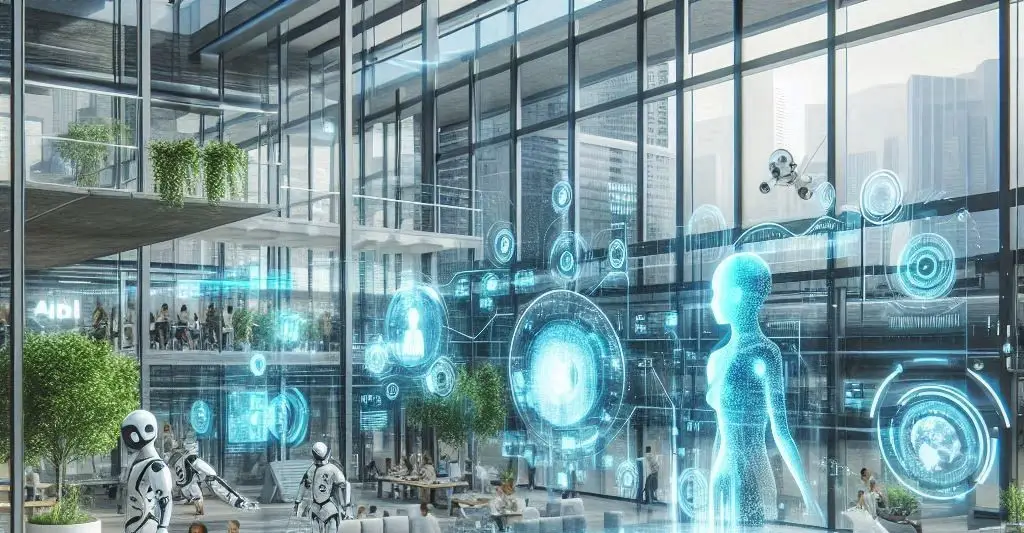
The physical office has transformed. It’s no longer a place for solitary work, which is often done more efficiently from a home setup with your AI co-pilot. Instead, the office is a hub for collaboration, brainstorming, and building culture—activities where human connection is irreplaceable.
The very nature of the employment contract has also evolved. With AI handling execution, employees are increasingly valued for their ability to identify problems, generate novel ideas, and build relationships. Compensation is tied less to hours worked and more to the value of your strategic input and creative contributions.
The Challenge: Navigating the Transition
The path to 2030 wasn’t without its challenges. The mid-2020s saw significant displacement for workers in roles that were highly automatable. The solution wasn’t to stop progress, but to accelerate reskilling and foster a culture of lifelong learning. Governments, educational institutions, and corporations had to collaborate on an unprecedented scale to manage the transition.
The defining divide in 2030 is no longer between the college-educated and non-educated, but between those who embrace adaptive, continuous learning and those who resist it.
Conclusion: A More Human Workplace
Paradoxically, the rise of artificial intelligence has made the workplace more human. By offloading the mundane and the calculable to machines, we have been forced to double down on what makes us uniquely human: our curiosity, our compassion, our intuition, and our ability to dream of a future that doesn’t yet exist. In 2030, we don’t work for AI; we work with it, using the most powerful tool we’ve ever created to amplify our own potential and tackle the world’s most complex challenges. The future of work isn’t about humans versus machines; it’s about humans, amplified.